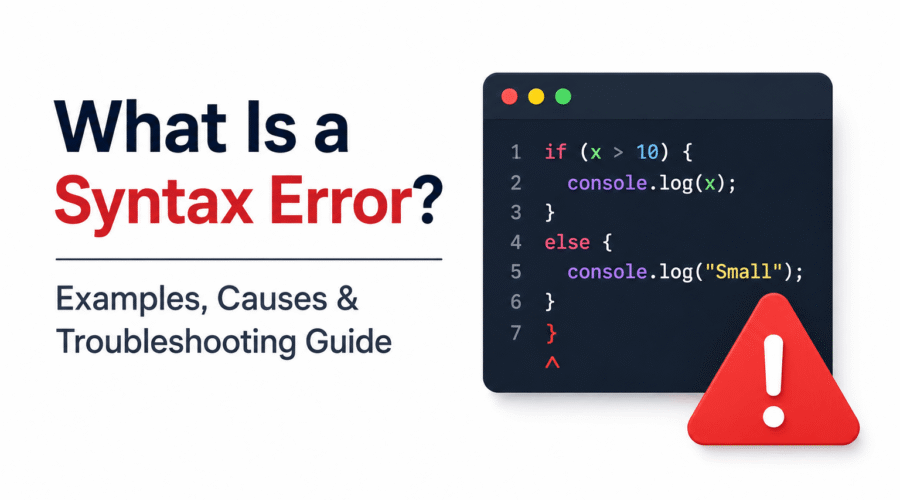
A syntax error occurs when source code violates the grammatical rules of a programming language. The compiler or interpreter cannot parse the code and rejects it before execution begins. Unlike runtime errors or logic errors, syntax errors are detected immediately: the program will not run at all until every syntax error is corrected.
Syntax errors are among the most common errors developers encounter, particularly when learning a new language, working with unfamiliar configuration formats, or writing scripts for automation tasks like code signing workflows. Understanding what causes them and how to read error messages makes them straightforward to resolve.
Syntax Errors vs Runtime Errors vs Logic Errors
Programming errors fall into three categories, each detected at a different stage:
| Error type | When detected | Example | Can the program run? |
| Syntax error | Before execution (at parse/compile time) | Missing closing bracket, misspelled keyword | No: program will not start |
| Runtime error | During execution | Division by zero, null pointer access, file not found | Program starts but crashes when the error line is reached |
| Logic error | Only by observing incorrect results | Signing with wrong certificate, wrong file path, off-by-one loop | Program runs to completion but produces wrong results |
Syntax errors are in one sense the easiest type to fix: they are always caught before the program runs, the error message includes a line number, and the problem is structural rather than behavioral. A runtime error requires understanding program state; a logic error requires understanding what the program is supposed to do. A syntax error just requires fixing the code structure.
Common Causes of Syntax Errors
Missing or mismatched brackets, braces, and parentheses
Opening brackets, braces, or parentheses that are not closed, or closing tokens that don’t match their opening token, are among the most frequent causes of syntax errors. Modern IDEs highlight matching brackets in real time, making this easier to catch before running code.
| # Python: missing closing parenthesis
result = Set-AuthenticodeSignature -FilePath ‘script.ps1’ -Certificate $cert -TimestampServer ‘http://timestamp.digicert.com’ # Missing backtick for continuation
# JavaScript: mismatched brackets in JSON signing config const config = { win: { certificateFile: “cert.pfx”, certificatePassword: “secret” } # Missing closing brace for outer object
# Correct version: const config = { win: { certificateFile: “cert.pfx”, certificatePassword: “secret” } } |
Missing semicolons or incorrect statement termination
Languages like JavaScript, Java, and C require semicolons to terminate statements. Omitting them can cause the parser to interpret two separate statements as one, resulting in a syntax error or unexpected behavior. Some languages (Python, Go) do not use semicolons; adding them produces a syntax error in those languages.
| # JavaScript: missing semicolons in an electron-builder signing hook
const { notarize } = require(‘@electron/notarize’) # Missing semicolon exports.default = async function notarizing(context) { if (context.electronPlatformName !== ‘darwin’) return # Missing semicolon return await notarize({ appPath: `${context.appOutDir}/${context.packager.appInfo.productFilename}.app` # Missing comma appleApiKey: process.env.APPLE_API_KEY }) } |
Incorrect indentation (Python and YAML)
Python uses indentation to define code blocks. Inconsistent indentation (mixing tabs and spaces, or using the wrong number of spaces) is a syntax error in Python. YAML, used in GitHub Actions workflows and configuration files, is similarly sensitive to indentation: two spaces versus four spaces, or tabs instead of spaces, can break the structure entirely.
| # YAML: incorrect indentation in a GitHub Actions signing workflow
# This will cause a YAML parse error: steps: – name: Sign executable run: | signtool sign /fd sha256 /a /tr http://timestamp.digicert.com YourApp.exe # ^ one space instead of two: YAML indentation error
# Correct: steps: – name: Sign executable run: | signtool sign /fd sha256 /a /tr http://timestamp.digicert.com YourApp.exe |
Mismatched or unclosed string delimiters
A string that starts with a double quote but ends with a single quote, or a string that is never closed, causes a syntax error. This is common when string values contain the same quote character that delimiters the string, requiring escaping.
| # JSON: unescaped quote in a string value (common in signing config files)
# Wrong: the certificate path is not properly quoted in JSON { “certificateFile”: “C:\Users\JohnDoe\cert.pfx with spaces” # ^ path with spaces needs proper quoting }
# Correct: backslashes in JSON strings must be escaped as double backslash: { “certificateFile”: “C:\\Users\\JohnDoe\\cert.pfx” }
# Or use forward slashes (also valid in Windows paths in JSON): { “certificateFile”: “C:/Users/JohnDoe/cert.pfx” } |
Misspelled keywords and reserved words
Misspelling a language keyword causes the parser to see an identifier where it expects a keyword, producing a syntax error. In PowerShell signing scripts, common misspellings include cmdlet names (Set-AuthenticodeSignaure instead of Set-AuthenticodeSignature), parameter names (-TimestampSever instead of -TimestampServer), and parameter switches (-Force written as -Forc).
| # PowerShell: misspelled cmdlet name in a signing script
# Wrong: > Set-AuthenticodeSignaure -FilePath .\Script.ps1 -Certificate $cert Error: The term ‘Set-AuthenticodeSignaure’ is not recognized as the name of a cmdlet
# Correct: > Set-AuthenticodeSignature -FilePath .\Script.ps1 -Certificate $cert -TimestampServer ‘http://timestamp.digicert.com’ |
Type mismatch in strongly typed languages
Compiled languages like Java, C#, and Go enforce type requirements at compile time. Assigning a value of the wrong type to a variable, or passing the wrong type to a function, is a compile-time error analogous to a syntax error in effect: the code does not compile and cannot run.
How to Read Syntax Error Messages
Error messages from compilers and interpreters consistently provide the same categories of information. Reading them systematically makes syntax errors faster to resolve.
- File name: Which file contains the error. In multi-file projects, this identifies the specific file to examine.
- Line number: The line where the parser detected the problem. Note that the error is sometimes reported on the line after the actual mistake: if a statement on line 10 is missing a closing parenthesis, the error may be reported on line 11 where the parser encounters unexpected content.
- Column number: Some parsers include the column position within the line, pinpointing the exact character where parsing failed.
- Error description: A description of what the parser expected versus what it found. Typical messages include ‘unexpected token,’ ‘expected identifier,’ ‘unexpected end of input,’ or ‘invalid syntax.’
| # Python syntax error message example:
File ‘sign_release.py’, line 15 certificate_path = ‘C:\certs\signing.pfx’ ^ SyntaxError: EOL while scanning string literal # Interpretation: the string on line 15 is not properly closed # (the backslash before the closing quote is escaping the quote)
# PowerShell parse error example: At C:\Scripts\sign.ps1:8 char:5 + Set-AuthenticodeSignaure -FilePath $file + ~~~~ The term ‘Set-AuthenticodeSignaure’ is not recognized… # Interpretation: misspelled cmdlet name on line 8, starting at character 5
# JSON parse error example (from electron-builder): Error: Failed to parse: Unexpected token } in JSON at position 234 # Interpretation: there is a structural problem near character 234 # (often a missing comma on the previous element) |
Tools That Catch Syntax Errors Before You Run
Modern development tools provide syntax error detection without requiring you to run the code:
- Integrated development environments (IDEs): Visual Studio Code, JetBrains IDEs, and others highlight syntax errors in real time as you type. Red underlines appear under problematic code. Hovering over the underline shows the error description. This provides immediate feedback without needing to save or run the file.
- Language servers: The Language Server Protocol enables editor-agnostic syntax checking. Editors like VS Code use language servers (Pylance for Python, TypeScript language server for JavaScript/TypeScript, PowerShell Extension for PowerShell) that continuously parse code and report errors.
- Linters: Tools like ESLint (JavaScript), pylint (Python), and PSScriptAnalyzer (PowerShell) analyze code for syntax errors and style issues. PSScriptAnalyzer is particularly useful for signing scripts: it validates PowerShell syntax and flags common mistakes in automation code.
- Schema validation for JSON/YAML: Tools like jsonlint.com validate JSON syntax. VS Code’s YAML extension validates YAML structure and can validate against specific schemas (like GitHub Actions workflow schema) to catch structure errors before committing.
For YAML-based GitHub Actions workflows that include code signing steps, use the GitHub Actions VS Code extension or validate your YAML against the Actions schema. The GitHub Actions YAML schema catches both syntax errors and logical structure errors (wrong keys, invalid event names) before you push to the repository. A workflow YAML with a syntax error will fail immediately upon push with a parsing error in the GitHub UI.
Frequently Asked Questions
What is a syntax error?
A syntax error is an error in source code that violates the grammatical rules of the programming language. The compiler or interpreter cannot parse the code when a syntax error is present and the program cannot execute. Common causes include missing brackets, incorrect indentation (in Python and YAML), misspelled keywords, unclosed strings, and missing statement terminators. Syntax errors are always detected before the program runs and always include a line number in the error message.
What is the difference between a syntax error and a runtime error?
A syntax error is detected before the program runs: the code structure is invalid and cannot be parsed. A runtime error occurs during execution: the code is syntactically valid and starts running, but encounters a problem at a specific point (such as attempting to open a file that doesn’t exist, dividing by zero, or calling a method on a null object). A syntax error prevents the program from starting. A runtime error causes it to crash partway through.
The error message points to a line, but the problem seems to be on a different line. Why?
This is common with bracket and delimiter mismatches. The parser does not detect the error when it reads the opening bracket; it detects it when it reaches content that is invalid given the unclosed bracket. If a function definition on line 5 is missing its closing brace, the parser may report the error on line 12 when it encounters the next function definition keyword: from the parser’s perspective, the first function is still open. Work backwards from the reported line to find the actual location of the missing or mismatched token.
I copied code from documentation and it has a syntax error. Why?
Documentation sources introduce syntax errors through: copy-paste from formatted web pages that replace straight quotes with typographic (‘curly’) quotes, line breaks inserted mid-string or mid-expression in documentation layout that don’t exist in executable code, missing context (variables or imports not shown in the excerpt), and code samples written for a different version of the language. When copying from documentation, use a plain text editor or IDE and verify that quote characters are straight (not curly), that the code is complete and in context, and that the language version matches your environment.
Published: March 2023 | Last Reviewed: June 2026 | Category: Programming / Syntax Errors / Debugging / Developer Tools

Gloria Bradford is a renowned expert in the field of encryption, widely recognized for her pioneering work in safeguarding digital information and communication. With a career spanning over two decades, she has played a pivotal role in shaping the landscape of cybersecurity and data protection.
Throughout her illustrious career, Gloria has occupied key roles in both private industry and government agencies. Her expertise has been instrumental in developing state-of-the-art encryption and code signing technologies that have fortified digital fortresses against the relentless tide of cyber threats.
Gloria Bradford
Gloria Bradford is a renowned expert in the field of encryption, widely recognized for her pioneering work in safeguarding digital information and communication. With a career spanning over two decades, she has played a pivotal role in shaping the landscape of cybersecurity and data protection. Throughout her illustrious career, Gloria has occupied key roles in both private industry and government agencies. Her expertise has been instrumental in developing state-of-the-art encryption and code signing technologies that have fortified digital fortresses against the relentless tide of cyber threats.